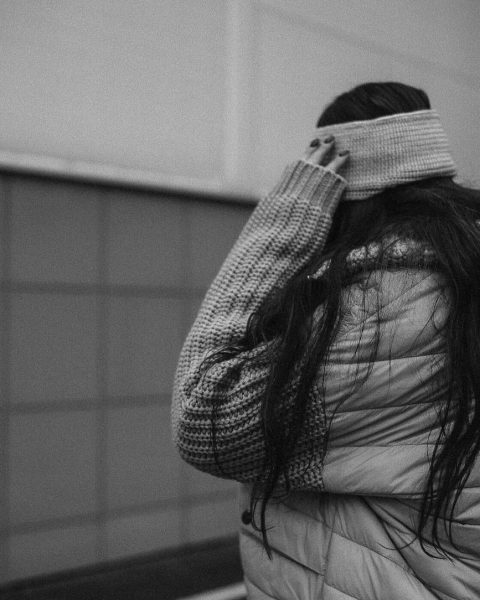
You've buttoned the coat, stepped outside, and the wind finds your ears first. A knitted headband covers them without crushing your whole head of hair the way a beanie does, and it looks deliberate with a winter coat when three things agree: the band's bulk, its color, and where it sits against the collar.
Get those right and the band reads as part of the outfit rather than something you grabbed on the way out.
Match the band's bulk to the coat's collar
Scale is what makes or breaks the pairing. A chunky cable-knit band suits a puffer, a parka with a shearling collar, or any coat that already has volume around the shoulders, because the extra bulk at your head balances the bulk below it. With a slim wool overcoat or a tailored peacoat, a thinner rib knit or fine-gauge band keeps the outline clean; a thick one on top of a narrow collar makes your head look oversized.
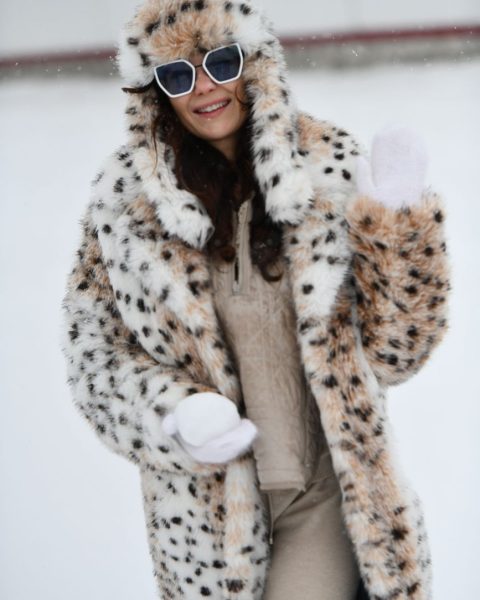
Twisted or knotted fronts sit somewhere in between. They put a focal point at your forehead, so they work best with a plain coat and look busy next to a fur-trimmed hood or a loud pattern.

If you raise your hood on sleety days, choose a band thin enough to fit underneath. A bulky ear warmer headband pushes the hood back off your forehead and lets cold air in at the sides.
Fiber matters as much as thickness. Wool and wool blends hold much of their warmth even when damp, which counts in wet snow. Acrylic costs less and machine-washes easily, but it tends to pill and traps more sweat on a long walk. A fleece lining adds warmth and cuts some of the wind that slips through an open knit.
Tie the color to something already in the outfit
A band that repeats one color you're already wearing looks planned. With a black, navy, gray, or camel coat, the band can be your accent color, as long as that color shows up once more, in gloves, a scarf, or even a sweater at the neckline.
With a bold coat, such as red or cobalt, let the band step back: cream, charcoal, or a shade that matches your boots. A tonal choice, one or two shades lighter than the coat, frames your face without competing with it.
Watch texture, too. If your scarf is a heavy cable knit, a smoother ribbed band keeps the two from fighting for attention.
Put it on in this order
The sequence matters because the band, collar, and scarf overlap, and doing them out of order leaves gaps at the neck or snags your hair.
- Style your hair first. A low bun or ponytail sits neatly below the band at the back; a high ponytail or top knot sits above it. Loose hair can go under the band at the back, with the band resting on top of it.
- Put the band on before the coat, in front of a mirror, so the collar doesn't catch it.
- Set the front edge at or just behind your hairline, then check that the sides fully cover your earlobes. Wearing it high on the ears defeats the purpose.
- Slide the back down to the nape, below the curve of your skull. Placed there, the band anchors itself and won't creep up when you turn your head.
- Pull out any face-framing strands now, while you can still see the front.
- Put on the coat and settle the collar so its top edge meets the bottom of the band at the back. That overlap closes the cold spot at the base of your neck.
- Add the scarf last, wrapping it so it covers the collar's edge rather than sitting under it.

Stop the band from flattening or frizzing your hair
Dry winter air plus wool or acrylic builds static. Smoothing a small amount of leave-in conditioner through your lengths before you put the band on cuts down on flyaways, and a band with a satin or silk lining reduces friction at the hairline.
A tight band leaves a dent across the crown. Placing it where your part or bangs will cover the line helps, or wear it with a ponytail so the dent doesn't show.
If you wear glasses, a thinner band presses the arms into your head less than a chunky one does.
Keep the fit snug through the season
A well-fitting winter headband stays put when you nod without leaving a red line or a headache after an hour. If it keeps sliding up at the back even when worn low at the nape, the knit has probably stretched.
Care keeps that from happening early. Wool shrinks and felts when hot water and agitation work on its fibers, so unless the care label says machine-washable, hand-wash wool bands in cool water with a gentle detergent and squeeze, don't wring. Dry them flat on a towel; hanging a wet band stretches it out of shape.
When you're choosing between two bands, try each on with the coat you'll actually wear, collar up and scarf on, since a band that looks right on its own can disappear or overwhelm once everything else is in place.