Cold toes in winter boots usually start as damp toes. Your feet keep sweating in freezing weather, and after an hour of shoveling, waiting on a train platform or walking the dog, that moisture has to go somewhere. Where it ends up decides whether your feet stay warm.
For most winter days in boots, merino wool socks are the better choice. They keep much of their insulation when they get damp, while cotton socks soak up sweat, hold it against your skin and turn cold once they're wet. Cotton still has a place, but a narrower one than its share of most sock drawers suggests.
Why damp cotton leaves your toes cold
Cotton absorbs water readily and gives it up slowly. A cotton sock can feel fine when you lace up and clammy an hour later, because the sweat has nowhere to go: the fibers hold it, and the boot's lining and any waterproof membrane slow evaporation even further.
Wet cotton also flattens. Insulation works by trapping still air in the fabric, and a soggy, compressed sock traps far less of it. Water conducts heat away from skin much faster than air does, so a damp sock doesn't just stop insulating; it pulls warmth from your feet.

That's why hikers, hunters and people who work outdoors have long warned against cotton in the cold. The problem grows with time and effort. A five-minute walk to the car on a dry day won't soak a sock, but a shift on a job site, a long commute between overheated buses and icy sidewalks, or a winter hike will. A thicker cotton sock doesn't fix this, since more cotton simply holds more water.
What merino wool socks do with sweat
Merino is wool from merino sheep, with fibers much finer than those of ordinary wool. That fineness is why most people find it soft rather than scratchy against bare skin.
Wool fibers can take up a fair amount of moisture vapor before the sock feels wet, and their natural crimp helps them keep their loft. A damp merino sock still holds a layer of warm air around your foot. It won't stay toasty after you step into a slush puddle over the boot top, but it loses far less warmth than cotton in the same state. Wool also tends to hold odor less than cotton, so a pair can get through a long day, or a second day on a trip, before it needs washing.
Most men's merino wool socks are blends. Nylon adds strength at the heel and toe, and a little elastane keeps the cuff from sliding down. A sock with no synthetic content at all tends to wear through sooner. Read the fiber list: you want merino as the main fiber, because a sock sold as wool that contains only a small share of it behaves much like a synthetic sock.
Care is where merino asks more of you. Heat combined with agitation can felt wool fibers and shrink the sock, so wash on a cool or wool cycle and skip the hot dryer unless the care label says low heat is fine.
How the two fibers compare in a boot
In dry, mild cold, the gap between the fibers is small; it widens as your feet sweat and the hours add up.
| Attribute | Merino wool | Cotton |
|---|---|---|
| Warmth when dry | Good, depends on thickness | Fair to good, depends on thickness |
| Warmth when damp | Keeps much of its insulation | Drops sharply |
| Drying time | Moderate | Slow |
| Odor between washes | Holds odor less | Holds odor more |
| Feel on skin | Soft for most people; some find it itchy | Soft and familiar |
| Shape over a long day | Holds shape well in blends | Can stretch and sag when wet |
| Washing | Cool wash, low or no dryer heat | Tolerates warm washes and the dryer |
Merino socks usually cost more per pair than cotton. Since cold-weather comfort depends on having dry socks, three or four good pairs you can rotate do more for your feet than a drawer full of cotton ones.
A sock that's too thick makes cold feet worse
Fiber is only half the choice. Most men's winter socks come in cushion levels, from thin liner weight through light and midweight to heavyweight, and the right one depends on how much room your boot has.
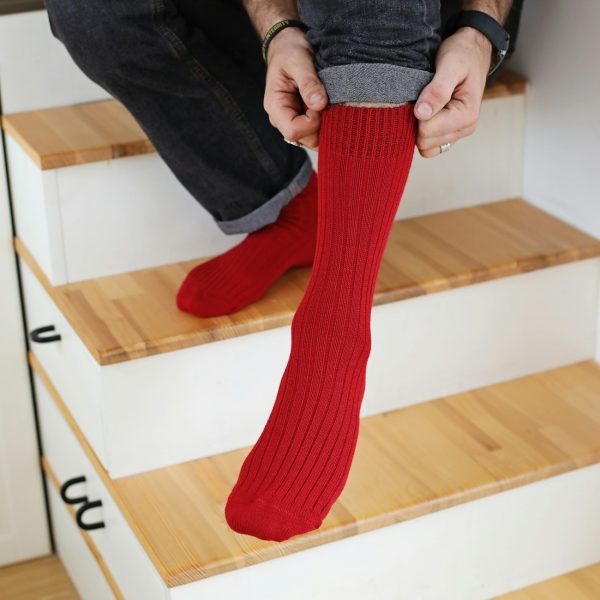
A heavy sock crammed into a snug boot squeezes your foot, restricts circulation and compresses the very insulation you paid for. Feet that can't move get colder, not warmer. When you try on boots, wear the socks you'll actually use with them, and make sure you can still wiggle your toes freely. If your boots already fit closely, a light or midweight merino sock will keep you warmer than a heavyweight one.
Socks for winter boots should rise above the boot collar so the shaft doesn't rub your shin, which usually means a crew or over-the-calf length.
Some people with very sweaty feet wear a thin liner under a midweight sock. The liner moves moisture away from the skin and lets the two layers slide against each other, which also cuts down on blisters. This only works if the boot has room for both.
Which sock suits which winter day
The right pick depends on how long you'll be out, how hard you'll be moving and how much your feet sweat.
- Daily commute in insulated boots: a light or midweight merino sock handles the swing between heated trains and cold streets. Cotton is tolerable if the trip is short and you can change at work.
- Standing still outdoors, at a job site, a football game or an ice-fishing hole: the warmest merino your boots can fit without pinching, plus a spare pair to change into halfway through.
- Winter hiking or snowshoeing: a midweight merino blend with reinforced heel and toe, and a dry pair in your pack for the drive home.
- Feet that sweat heavily: merino or a merino-synthetic blend, possibly with a liner. Cotton is the worst fit here.
- Skin that reacts to wool: a thermal sock made of synthetics such as polyester, acrylic or polypropylene still beats cotton, because it doesn't hold water the same way.
- Quick errands in dry cold: ordinary cotton socks are fine for a short trip outside.
If you're buying warm socks for men as a gift and don't know how their boots fit, a midweight merino crew sock is a reasonable middle option: it fits most boots without crowding and rises above the collar. And whatever you wear, pull on a fresh, dry pair right before heading out rather than keeping the ones you've had on indoors all morning, since a sock that's already damp starts the day losing heat.