A men's wool overcoat is one of the few pieces of clothing you might wear for ten or fifteen winters, and the ones that end up at the back of the closet usually have a flaw you could have spotted in the fitting room: shoulders that pull over a suit jacket, a hem that stops above the jacket's, or a shell so thin that the wind cuts through by November.
Three things decide whether a coat earns that long life: how it fits over your layers, how far it reaches down your leg, and what the fabric is made of. Color and pattern come after, and the construction details tell you whether the coat will hold its shape once you've bought it.
Fit the coat over the jacket you'll wear under it
Bring the layer you'll actually wear underneath when you try a coat on. A coat that sits well over a T-shirt can bind across the back over a blazer or a chunky sweater, which is why a good coat can feel wrong in January.
Start with the shoulders, because they're the hardest part for a tailor to change. The shoulder seam should land at the edge of your shoulder bone or slightly past it, with no dent in the sleeve below. If the seam sits inward, the coat is too small no matter how well it buttons.

Next, button it up and look at the front. Fabric that pulls into an X around the buttons means the chest or waist is too tight; a little ease is right, since you need room to move and air to keep you warm. Then reach forward as if grabbing a steering wheel and raise both arms. The back shouldn't strain across the shoulder blades, and the sleeves shouldn't ride halfway up your forearms.
Good overcoat fit at the cuff means the sleeve covers your jacket sleeve completely and ends around the base of your thumb with arms at your sides. Most overcoats are cut with room for a jacket underneath, so many men take their usual jacket size, but brands size differently and a size chart only gets you close.
Choose an overcoat length for how you get around
The right overcoat length depends less on fashion than on your day. If you wear suits or sport coats, the coat has to cover the jacket's hem by a few inches; a jacket peeking out below the coat looks unfinished and lets cold air in.
For most men, a coat that ends just above or at the knee is the most versatile choice. It covers a suit jacket, it works with jeans, and it doesn't tangle around your legs on stairs or when you get into a car.
The main options trade warmth for ease of movement:
- Hip to mid-thigh coats, often called car coats, suit drivers and casual wardrobes but don't cover a longer suit jacket.
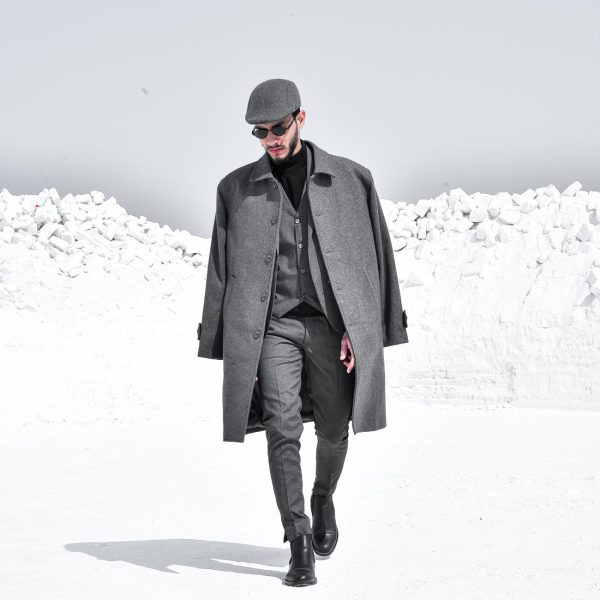
- Just-above-knee to knee-length coats cover tailored jackets and work for commuting on foot or by train.
- Below-knee coats are the warmest and most formal, but they weigh more, can overwhelm a shorter frame and get in the way on a bike.
If you're on the shorter side, a coat that ends at or above the knee keeps your legs from looking cut off. Taller men can carry a longer coat more easily, though it still needs to clear the stairs.
Read the fiber label before the price tag
In the US, wool garments must carry a label listing fiber content by percentage, and that label tells you more than any product name. A coat called "wool" might be mostly wool or mostly polyester.
A high wool content gives you the qualities people buy a wool overcoat for: warmth that holds up even when the fabric gets a little damp, a shell that breathes, and a drape that recovers from creasing. A modest share of nylon or polyester adds durability at the cuffs and pocket edges and lowers the price, which is a reasonable trade. Once synthetics make up the larger share, expect less warmth for the coat's weight, more static, and pilling where your bag strap rubs.
Cashmere blends feel softer and lighter, but cashmere wears faster at the cuffs and collar, so a coat that's all or mostly cashmere is a luxury rather than the hardest-working choice.
The weave matters as much as the fiber. Melton is densely woven and felted, so it blocks wind well and keeps a clean, smooth look. Tweed is rougher, more casual and very tough. If the label or listing gives a fabric weight, heavier cloth generally means a warmer, more structured coat; hold the fabric up to the light, and if you can see through it easily, it won't stop much wind.
Check the lining too. Viscose and cupro linings breathe better than polyester and let the coat slide over a jacket without sticking.
Herringbone, black or something in between
A herringbone wool overcoat has a woven zigzag that adds texture without loud pattern. That texture hides lint, light dust and small marks better than a flat, solid cloth, and it pairs well with both suits and casual clothes. The pattern should match at the center back and across the front closure; mismatched chevrons are a sign of rushed cutting.
A black wool overcoat is the most formal option and works over a dark suit or for evening events, but it shows every fleck of lint, dandruff and pet hair. If you'll wear the coat every day, charcoal and navy give you nearly the same versatility with far less brushing. Camel looks sharp with gray and navy, but it shows street grime around the hem and cuffs.
Signs of a coat that won't last the decade
A cheap coat usually gives itself away in the details. A chest that feels stiff like cardboard often means a heavily fused front, where glued interlining can bubble after rain or cleaning. Puckered seams, loose threads at the pocket corners and buttons sewn tight against the cloth without a thread shank all point to hurried work. Buttons need that shank to sit flat over the thick fabric when fastened.
A few final checks take only a minute in the fitting room or the first day after delivery:
- Sit down with the coat buttoned and make sure it doesn't pull open or bunch at the hips.
- Read the care label, since many wool coats call for dry cleaning only, which adds to what the coat costs over the years.
- Ask whether the sleeves can be shortened easily; cuffs with working buttonholes are harder and costlier to alter.
- Put your usual bag on your shoulder and check that the strap doesn't crush the shoulder line.
- Keep the tags on until you've tried the coat over every layer you plan to wear.
Once the coat is yours, hang it on a wide, shaped hanger and give it a soft brushing after wear, which keeps wool looking good for far longer than frequent cleaning does.