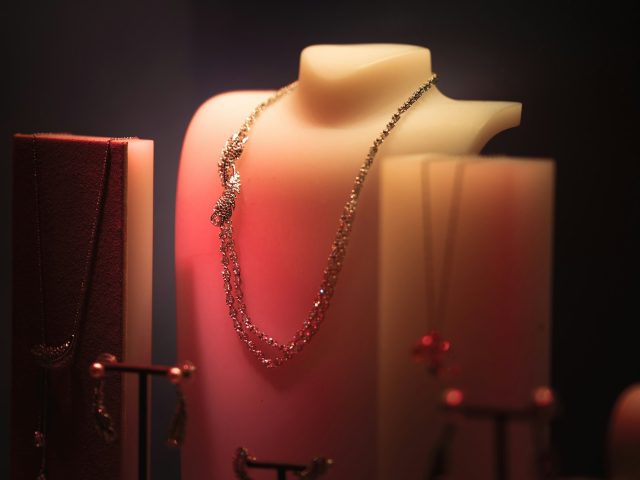
Most holiday party outfits are planned from the dress or top down, and the jewelry gets decided in the last ten minutes. That's when a statement necklace goes wrong: a wide bib crowding a crew neck, a long chain lost against sequins, a heavy collar that slides back by the second drink.
Start with the neckline you already have. The cut of the top tells you the shape and length that will work, the fabric and color narrow the finish, and the event itself decides how much weight and swing you can live with. Choose a necklace for your neckline first, and the rest of the decision gets much smaller.
Let the cut of your top choose the shape
Think of the neckline as a frame: the necklace should sit inside the open skin or follow its line, and it shouldn't cross the edge of the fabric at an awkward point. A collar that lands half on skin and half on a high neckline looks as if it slipped.
Each common cut points toward a different shape:

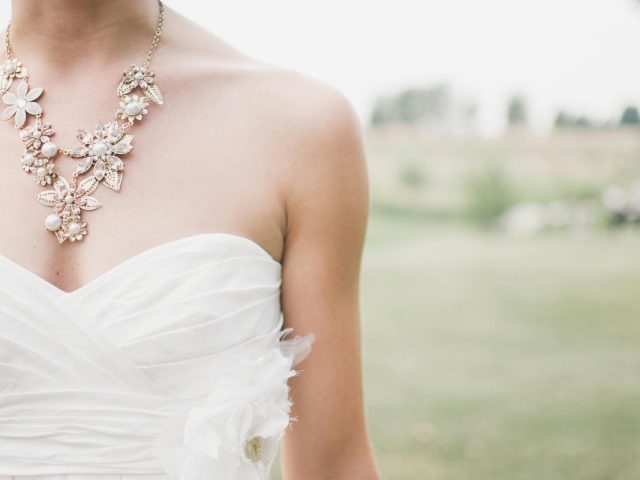
- Strapless and sweetheart: a wide stretch of open skin, and a natural home for bib statement necklaces. A bib or collar that rests on the collarbones fills the gap without reaching the bodice.
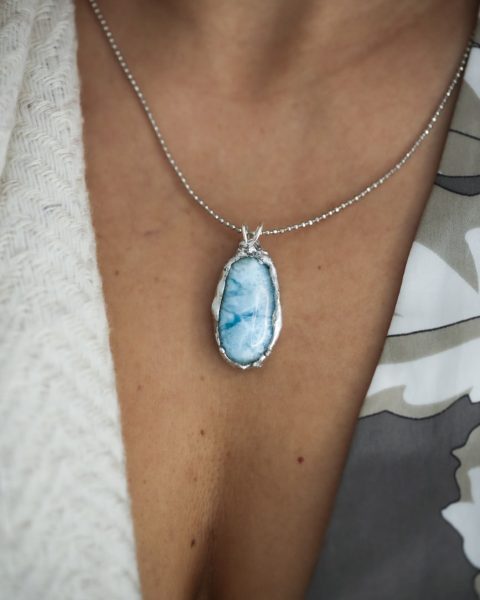
- V-neck: echo the angle with a pendant, a Y-shape or a drop that ends an inch or two above the point of the V. A round collar fights the line.
- Scoop: follow the curve with a rounded collar or a short bib that leaves an even margin of skin above the fabric.
- Square neck: a short collar or an angular piece sits neatly inside the square; avoid anything that hangs past the top edge.
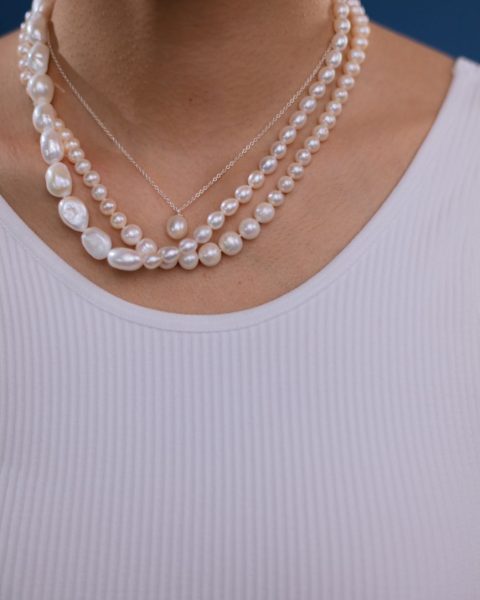
- Crew neck and turtleneck: go over the fabric with a long statement necklace that falls to mid-chest or lower, or wear a chunky piece just above a crew neck. Skip the short collar on a turtleneck.
- Boat neck and off-the-shoulder: a choker or close collar works with the horizontal line; a long pendant cuts across it.
- Ruffled, beaded or embellished necklines: the top is already the statement. Let earrings carry the jewelry and leave the neck bare.
Length labels help when you're shopping online. As a rough guide on most adults, about 16 inches sits at the base of the neck, 18 inches at the collarbone, 20 to 24 inches on the upper chest, and 28 inches or more well down the torso. Measure a necklace you already own against yourself to translate those numbers, since neck size and build shift where each length lands.
Gold, black or color depends on fabric and light
A gold statement necklace is the easy match for the holiday palette: it warms up red, deep green, navy, cream and black, and warm indoor lighting flatters it. The exception is a gold or heavily metallic dress, where a big gold piece competes with the fabric; there, a crystal or black piece reads more clearly. Mixing metals works when it looks deliberate, as with a necklace that already combines gold and silver tones.
Black statement necklaces, in jet-style glass, black crystal, enamel or onyx, look sharpest on white, ivory, red, silver and metallic fabrics. On a black dress they become tonal texture, which can look elegant up close but often disappears in dim rooms and party photos. If you want black on black, pick something with shine, such as faceted crystal or a gold or silver setting that outlines the shape.
Colored stones work best when they repeat one color already in the outfit, from a shoe or a print. A necklace that introduces a new color usually ends up looking like it came from a different evening.
Weight and clasp decide how the evening feels
A heavy necklace looks great in the mirror and becomes a problem after an hour. Weight pulls the front down and the clasp up the back of the neck, and on thin fabrics such as silk or jersey it can pull the neckline with it. Before buying, hold the piece in one hand for a minute: if it feels heavy there, it will feel heavier on your neck by the end of the night. Larger stones, solid metal and dense beading all add weight, so the most impressive pieces cost you in comfort as well as money.
Look closely at the clasp. A lobster clasp holds weight better than a small spring ring, and magnetic clasps are easy to fasten but can let go when a heavy piece gets tugged. An extender chain of a few inches is worth having on a collar or bib, because it lets you raise or lower the piece to suit each neckline you wear it with.

At a seated dinner, a long pendant swings into plates and glasses; on a dance floor, loose beads and long strands bounce against you. A short, close-fitting piece stays put in both settings.
Warning signs of a necklace that won't last the season
Turn the necklace over before you judge the front. Stones held in metal prongs or bezels stay put far better than stones glued into shallow cups, and visible glue around the edges, cloudy residue or stones that wobble when you tap them are signs a piece will start shedding.
Read the metal description carefully. "Gold-tone" describes only the color. Gold-plated means a thin layer of gold over a base metal, which can wear through where the necklace rubs against skin or fabric; gold-filled has a much thicker bonded layer and lasts far longer. Darker metal showing at the edges or the clasp of a display piece tells you the plating is already thin.
Check how the parts connect. Small open jump rings can pull apart under the weight of a bib, and links with sharp edges catch on knits and lace. If your skin reacts to some costume jewelry, look for pieces with the metal listed in full and sold as nickel-free, and remember that plating can wear off and expose the base metal, especially on a collar that sits directly on the skin.
Four checks before you commit
Do these in the actual outfit, with your hair and shoes as they'll be on the night:
- Step back about six feet from a mirror and see whether the necklace still reads as one clear shape from that distance.
- Sit down and lean forward as if reaching for a glass, then check whether the piece has shifted or flipped.
- Take a photo with your phone's flash on, since some stones turn into white glare and black pieces can vanish.
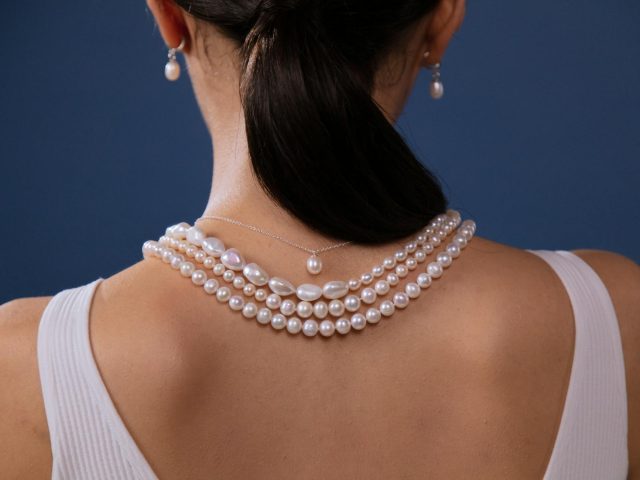
- Look at the sides with your hair as you'll wear it; hair worn down covers a collar's edges, while an updo shows the back of the clasp and every bit of chain.
If the necklace is new, wear it around the house for an hour before the party. A clasp that creeps to the front or an edge that scratches will show up long before the first toast.