The bunching usually shows up an hour in: a ridge of fabric around your waist, shirt sleeves twisted at the elbow, one collar point trapped under the neckline. A collared shirt and sweater look sharp together only when the shirt lies flat underneath, which takes a thin shirt that fits close, a secure tuck and settling each layer before you add the next.
Most of the work happens before the sweater goes over your head. Get the shirt right and the rest takes a minute.
Start with a thin shirt that fits close
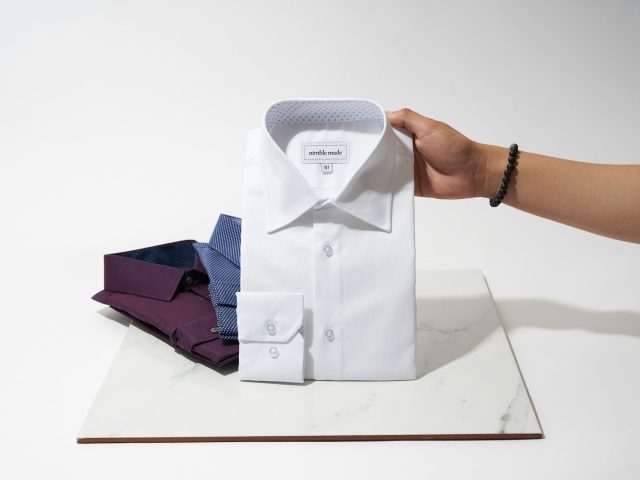
The shirt under a sweater is the layer that bunches, so its fabric and cut matter more than the sweater's. Smooth, tightly woven cottons such as poplin and broadcloth are thin enough to disappear under a knit. Oxford cloth is a little heavier but still works under a fine sweater. Flannel and thick chambray add so much bulk at the waist and arms that they're better worn on their own or open over a T-shirt.
Fit counts as much as fabric. A shirt with spare width across the back and waist has nowhere to go but into folds once a sweater presses it down. If the shirt you love is roomy, pair it with a looser sweater or a cardigan, which leaves the extra fabric room to hang.

Set these out before you dress, because swapping one piece halfway through means starting over:
- a shirt that's pressed, or at least free of deep creases, since wrinkles turn into ridges under a knit
- a sweater in a fine or medium knit, such as merino or thin cotton
- pants with a waistband snug enough to hold a tuck, or a belt
- collar stays, if your shirt has slots for them under the collar points
How to layer a sweater over a collared shirt
Work from the inside out, and don't move to the next step until the current layer is smooth.
- Button the shirt, cuffs included. Fastened cuffs stay at your wrists later, when the sweater sleeves try to drag them upward. Leave the top button open unless you're wearing a tie.
- Tuck it tight. Pull the shirt down so it's taut from shoulders to hem, then tuck it into your pants. For a flatter result, use a military tuck: pinch the spare fabric at each side seam, fold it toward your back and hold it in place while you fasten the waistband.
- Stand the collar up. A raised collar can't get caught and folded under the sweater's neckline on the way down.
- Hold your cuffs as you put on the sleeves. Grip each shirt cuff with your fingertips while you push that arm through the sweater sleeve. This keeps the shirt sleeve from twisting or riding up at the elbow.
- Pull the sweater down by its hem. Tugging at the neckline stretches it; drawing the hem down settles the body evenly. Then reach under the back hem and give the shirt one more downward pull, since the back is where folds collect unseen.
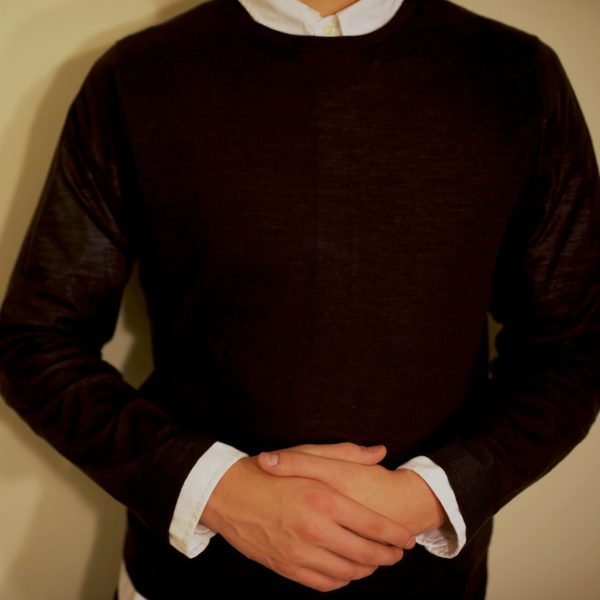
- Fold the collar down and set the points. With a crewneck, the collar band sits just above the sweater's neckline and the points rest on top of the knit. With a V-neck, the points lie inside the V. Slide in collar stays now if you use them.
- Settle the cuffs. As a rough guide, let the shirt cuffs show about a quarter to half an inch past the sweater cuffs. If you'd rather push your sleeves up, push both layers together so the shirt doesn't gather in a lump at the forearm.
Check yourself sideways in a mirror once you're done. A smooth line from chest to waist means the tuck held; a bulge just above the belt means it's worth redoing step two.
Women's and men's shirts are often cut differently
Many women's collared shirts are cut closer at the waist, some with darts, so they tend to bunch less at the sides but can pull across the bust once a sweater presses on them. Size for the bust and smooth the waist with the tuck. Shorter, boxier styles often work better with a front tuck, where only the front panel goes into the waistband, under a cropped or relaxed sweater.
Men's collared shirts usually have longer tails, cut to stay tucked, which is exactly why they bunch under a sweater hem when worn loose. A slim or tailored fit generally layers more cleanly than a classic cut with a full body.
Mistakes that bring the bunching back
A sweater that's too tight shows every fold beneath it. The knit should skim the shirt, with enough room that you can pinch a little fabric at the side.
An undershirt adds a third layer at the waist. If you want one, choose a thin, close-fitting style and tuck it in before the shirt.
Chunky cable knits and thick shawl collars push a shirt collar out of place and leave little room for the fabric underneath. Save them for a T-shirt or a heavier, looser shirt.
A loose tuck works its way out the first time you sit down. A belt helps hold it, and a quick re-tuck after you stand up fixes most of what the day undoes.
Next time you dress, try the cuff grip and the tug at the back hem first, then check the side view in a mirror.