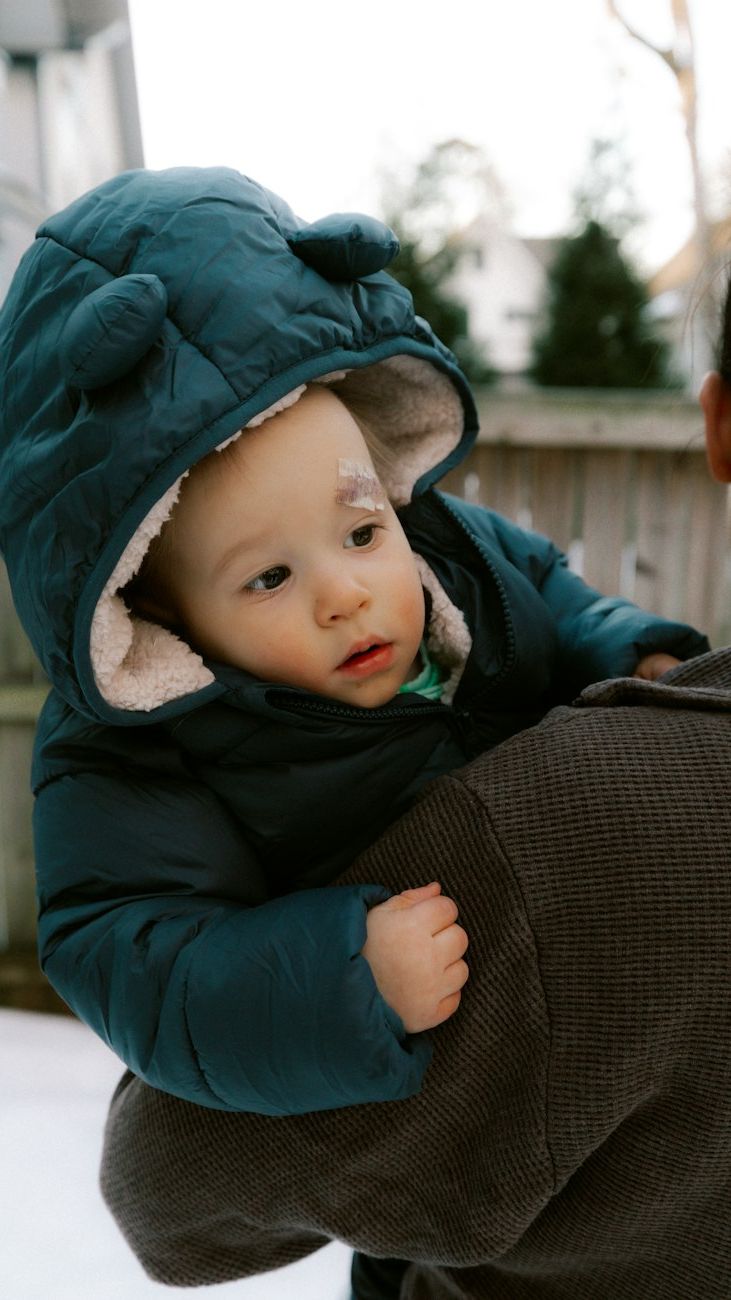
Puffy coats and car seats: how to keep a baby warm on holiday drives
Puffy coats and car seats: how to keep a baby warm on holiday drives
The car park is icy, the drive to Grandma's takes three hours, and your baby is zipped into a puffy snowsuit that looks perfectly sensible. Once you buckle that snowsuit into a car seat, it becomes a problem. Thick padding fills the space where the harness should sit against your child. In a crash the padding squashes flat, and the straps are left loose.
The fix is simple: dress your baby in thin layers, tighten the harness against their body, and put the warmth on top of the straps.
Why puffy coats leave the harness too loose
A harness protects a child only when it's snug against their body. Puffy coats are mostly trapped air, whether the fill is down or synthetic. The force of a crash pushes that air out almost instantly. Straps you tightened over the coat suddenly have room to spare, and a child can move forward and up out of them.
The same goes for snowsuits, bunting bags with thick backs and baby coats with heavy quilting. Winter car seat safety depends on how much bulk sits between your baby and the straps, not on how warm the coat is. A thin fleece jacket under the harness is fine. A thick, quilted one is not.
The risk doesn't show on a normal drive. A harness over a puffy coat can feel tight when you pull on it, because the padding pushes back.
What to pack for a warm ride
Keep the warmth removable, so it goes on after the buckles click and comes off once the car heats up.
- Thin layers: a long-sleeved bodysuit, leggings or footed pyjamas, and a thin fleece or jumper on top.
- A hat, mittens and warm socks or booties. They add warmth without touching the harness.
- One or two blankets to lay over your buckled child.
- Your child's regular coat, to wear backwards over the harness or to put on when you arrive.
- For an infant carrier, a car seat cover in the shower-cap style. It stretches over the top of the seat and has no layer behind the baby.
Skip anything that goes behind your baby or between your baby and the straps. That includes thick seat liners, padded bunting inserts and strap pads that didn't come with the seat. These add-ons haven't been crash-tested with your seat, and many manufacturers warn against them in the manual.
A car seat for a newborn often comes with its own infant insert. Use only that insert, and stay within the weight limits the manual gives for it.
Dress, buckle and cover in this order
Practise at home for the first few rides, so you aren't learning the routine in a cold car park.
- Warm up the car before you leave, if you can. Only ever run the engine outdoors, never in a closed garage, where carbon monoxide builds up.
- Dress your baby indoors in thin layers, a hat and booties.
- Buckle your baby in where it's warm. You can bring an infant carrier inside to do this. For a baby car seat that stays in the car, carry your child out in a coat or wrapped in a blanket, then take the coat off before buckling.
- Seat your child with their back and bottom flat against the seat, buckle up, and pull the harness tight. In the US, the chest clip goes at armpit level.
- Do the pinch test. Try to pinch a horizontal fold of strap at your child's collarbone. If you can pinch one, tighten the harness until you can't.
- Add warmth over the straps. Tuck a blanket over your child from the shoulders down, or slip their arms into a coat worn backwards. Keep the face clear.
- Remove layers once the car is warm. If the back of your baby's neck feels hot or sweaty, they're too warm.
Test any coat once, at home
If you're unsure whether a jacket is thin enough, test it on a quiet afternoon. Put the coat on your child, buckle them in and tighten the harness until it passes the pinch test.
Next, unbuckle without loosening the straps. Take the coat off and buckle your child back in. If you can now pinch slack at the collarbone, or the straps sit away from the chest, the coat is too bulky to wear under the harness.
Run this test on coats sold as ‘car seat friendly’ too. That label comes from the maker, and only the test shows how the coat fits your seat.
Mistakes that make a warm ride less safe
Don't loosen the harness to fit a coat ‘just this once’. Crashes often happen close to home, so a short drive across town needs a snug harness just as a long one does.
Keep blankets below your baby's chin, and never use them to prop up a slumping head. If a newborn's head flops forward, check the seat's recline angle against the manual.
Watch for overheating on long drives. Babies can't take off layers themselves, and a blasting heater on top of a hat and two blankets adds up fast.
Once you arrive, move a sleeping baby out of the car seat. US paediatric guidance calls for a firm, flat sleep surface, and a car seat isn't one.
Before the holidays, run the coat test with the jacket your child actually wears. Then pack the blanket where you can reach it from the car door.