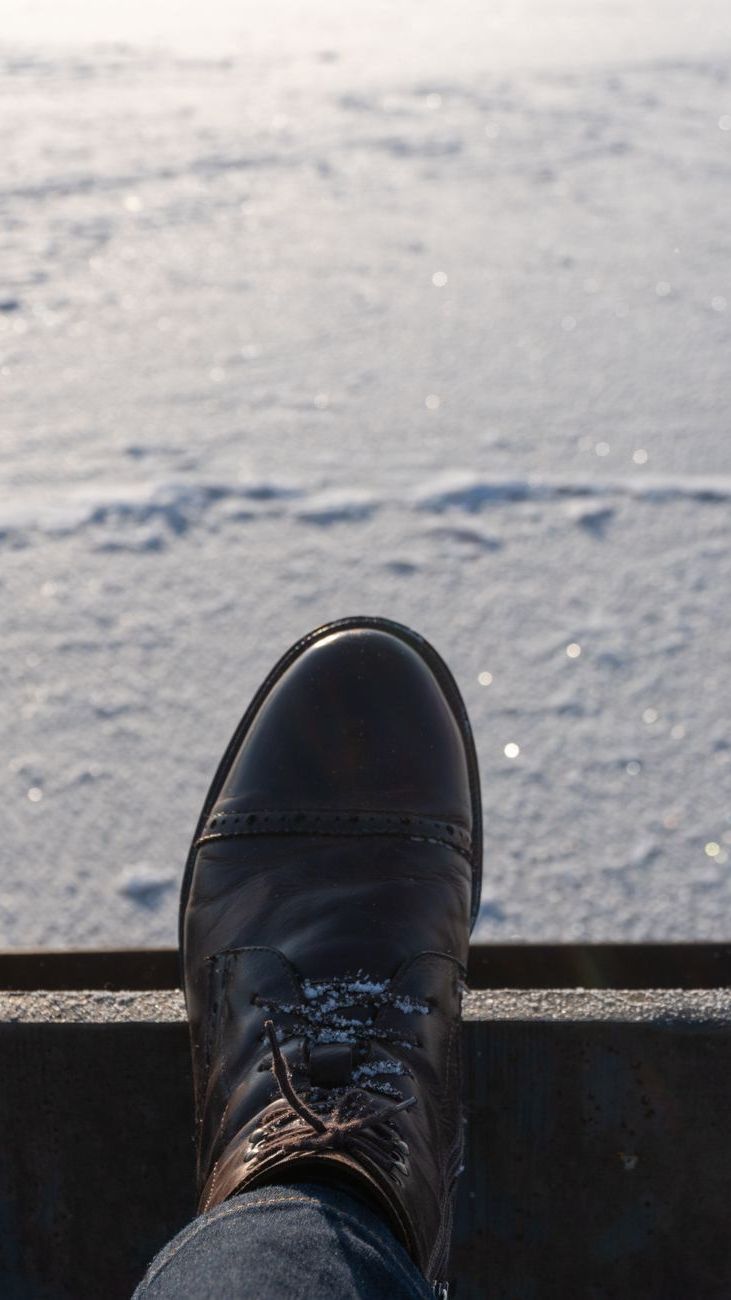
How to remove winter salt stains from leather and suede boots
How to remove winter salt stains from leather and suede boots
A slushy week leaves a wavy white line across the toes of your boots: salt from treated pavements, carried in meltwater and left behind as the water dries. You can remove salt stains with little more than a brush, a couple of cloths and a weak vinegar solution, provided you get to them before the salt has spent weeks drawing moisture out of the leather.
Check which material you're dealing with first. Smooth leather tolerates a damp cloth. Suede and nubuck need a drier, gentler approach, and the wrong method can leave a darker patch than the stain you started with.
What you need before you start
Most of what you need is already in your kitchen, and the rest usually comes in a basic boot care kit:
- Two or three soft, lint-free cloths
- White vinegar and lukewarm water
- A soft brush for leather, such as horsehair, or a suede brush and a suede eraser
- Leather conditioner or cream suited to the boot's colour
- Shoe trees, or plain paper to stuff the boots
A mix of roughly one part white vinegar to two parts water is a common starting point. Plain water dissolves salt too, but the vinegar helps break up the chalky film that water alone tends to smear around. Ready-made salt removers, sold alongside other boot care products, work along similar lines; if you use one, follow its label and test it the same way. Skip all-purpose household cleaners, which can strip dyes and finishes.
Wipe leather boots panel by panel
Smooth leather boots handle this well as long as the cloth stays damp rather than wet.
- Let the boots dry at room temperature, then brush off the loose white crust so you aren't grinding grains into the surface.
- Test the vinegar mix on a hidden spot, such as the inside of the heel collar or under the tongue, and let it dry. If the colour lifts or stays darker, use plain water instead.
- Dip a cloth in the mix and wring it out until it no longer drips.
- Wipe the whole affected panel, seam to seam, with light strokes. Treating only the mark tends to leave a fresh ring where wet meets dry.
- Go over the same area with a second cloth dampened in plain water to take off the vinegar and dissolved salt.
- Stuff the boots with shoe trees or paper and let them dry overnight away from heat.
- Once they're fully dry, work in a thin layer of conditioner with a clean cloth, let it absorb, then buff.
Salt that has soaked deep into the leather often wicks back to the surface as the boots dry, so a faint line may reappear the next day. Repeat the wipe and the drying; a couple more rounds often clear it.
If the leather feels stiff or shows fine cracks where the boot flexes, conditioner can soften it, but cracks won't close up again. A shoe repairer can tell you whether refinishing is worth it.
Treat suede boots dry before reaching for liquid
Suede has a soft, raised nap, and water mats the fibres and can leave tide marks of its own. Start dry and add moisture only if dry methods fail.
- Let the boots dry completely. Brushing damp suede pushes salt deeper and flattens the nap.
- Brush the stained area firmly in one direction, then back the other way, to break up the crust and lift the fibres.
- Rub a suede eraser over what remains with short strokes, then brush away the crumbs.
- If a mark persists, test the vinegar mix on a hidden spot, then dab the stain lightly with a cloth barely dampened in it, feathering outward so there's no hard edge.
- Blot with a dry cloth, stuff the boots and let them dry away from heat.
- Brush again once dry to raise the nap.
Suede usually looks darker while damp and lightens as it dries, so judge the result the next morning. Nubuck, which has a finer nap, takes the same approach with a lighter hand. Some colours fade slightly where you've worked, which is why the test spot matters.
Mistakes that set salt damage in for good
Drying boots with heat is the classic error. A radiator, electric heater or hairdryer drives moisture out of leather fast, and boots dried that way can stiffen, shrink and crack. Room temperature and an overnight wait give a better result.
Soaking causes trouble too. More water carries salt further into the leather and can weaken the glue on some soles, so keep cloths damp and never submerge the boots.
Putting the job off costs you as well, because salt keeps pulling oils from leather while it sits. And skipping conditioner after cleaning leaves smooth leather drier than before, so the next coat of salt does more harm.
Cut down on salt marks before the next storm
Good boot care in winter mostly means keeping salt from soaking in. Before the season, treat smooth leather with a wax or waterproofing product and suede with a protector spray made for it, and reapply as the label suggests, since both wear off with use. After a salty walk, wipe smooth leather with a damp cloth, or brush suede once it's dry. If you can, alternate two pairs so each gets a full day to dry out.
Tonight, let the pair by the door dry at room temperature, brush off the loose salt, then follow the steps for its material.